
Lawn Aeration in Hillsboro, OR: Service & Cost Guide
Professional lawn aeration Hillsboro, OR, homeowners schedule each season is one of the highest-return lawn care services available — it reduces water use by 20–30%, prepares a lawn for overseeding, and relieves the soil compaction that Hillsboro's clay-heavy Willamette Valley soils accumulate under regular foot traffic and equipment. HD Landscape and Maintenance is a licensed Washington County lawn care contractor (Oregon LCB #9977) with a 5.0-star rating from 302 reviews, providing professional core aeration service Washington County homeowners rely on.
By Donavan Hesedahl, Owner, HD Landscape and Maintenance · Last updated 19, June 2026
Core aeration is the secondary cultural practice that most Hillsboro lawns need but don't receive consistently — sitting behind mowing, fertilizing, and irrigation in the priority order, but ahead of most other lawn work in actual impact. This guide covers what aeration is, what it costs in the Hillsboro market, when to do it in Oregon's specific growing season, how often, and whether to combine it with overseeding.
For our lawn edging guide, see our lawn edging Hillsboro guide. For paver hardscape in the Washington County area, see our paver patio guide.
What is lawn aeration?
When clients ask what is lawn aeration, the answer is the mechanical process of pulling small soil cores (plugs) from the lawn surface to relieve compaction, reduce thatch buildup, and open channels for water, air, and nutrients to reach the root zone. Core aeration — also called core cultivation or aerification — uses a machine with hollow tines that penetrate the soil and deposit 2–4 inch soil plugs on the lawn surface.
What those soil cores accomplish:
Compaction relief: Hillsboro's Willamette silt loam soils compact under foot traffic, mowing equipment, and their own wet weight during Oregon's long rainy season. Compacted soil prevents water infiltration and root growth — grass roots hit resistance and turn shallow, which reduces drought tolerance and vigor. Per OSU Extension's research, core aeration can reduce lawn water use by 20–30% by improving the root zone's ability to absorb and hold moisture.
Thatch reduction: Thatch is the layer of dead stems and roots between the living grass blades and the soil surface. When thatch exceeds 1/2 inch, it can impede water and fertilizer penetration. Core aeration physically breaks up thatch and incorporates organic material back into the soil.
Seed-to-soil contact for overseeding: When aeration is followed by overseeding, the cores create direct soil contact for seeds — the exact condition that makes germination most reliable in the Pacific Northwest's fall planting window.
What aeration is not: it's not the same as spike aeration (which pushes soil aside and can worsen compaction in clay soils) or dethatching (which removes thatch aggressively but requires recovery time). Core aeration is the gentler, more effective long-term soil management tool for Hillsboro residential lawns.
How much does lawn aeration cost?
How much does lawn aeration cost in the Hillsboro and Washington County market in 2026:
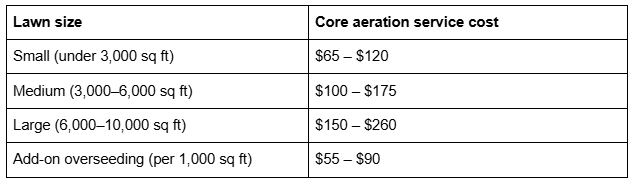
A typical Hillsboro residential lawn (4,000–6,000 sq ft) runs $110 to $200 for core aeration alone, and $250 to $420 for aeration plus overseeding with quality perennial ryegrass or tall fescue seed appropriate for western Oregon conditions.
The core aeration service in Washington County markets reflect Oregon labor rates and the additional mobilization time for Hillsboro and Washington County properties. Properties with significant slope, narrow side yards requiring manual equipment access, or heavy thatch requiring pre-service preparation may run toward the higher end of each range.
When is the best time to aerate a lawn?
When is the best time to aerate a lawn in western Oregon? Per OSU Extension's Practical Lawn Care for Western Oregon, both spring and fall are appropriate for Hillsboro and Washington County lawns — but they serve different goals:
Fall aeration (September–October) — the best window for combined aeration and overseeding. September is the ideal month for most Hillsboro lawns: the soil is still warm from summer, the heavy fall rains are imminent, and fall rain establishes newly seeded grass without the need for irrigation. An early September aeration followed immediately by overseeding allows perennial ryegrass — the dominant grass in western Oregon — to germinate and establish before the cold sets in. OSU Extension specifically notes that an early September soaking "makes fall coring or overseeding projects more effective."
Spring aeration (March–April) — the best window for compaction relief and water efficiency. Spring is excellent for root channel development: grasses produce new root systems in spring, and the aeration holes create channels for roots to grow deeper. Spring aeration without overseeding is appropriate for lawns with good turf density that simply need compaction relief heading into the growing season.
What to avoid: aerating in July or August when lawns are in summer drought stress — the open cores dry out quickly and turf recovery is slow. Don't aerate in December or January when soils are saturated — equipment will smear and compact soil rather than pulling clean cores.
Best lawn aeration service in Hillsboro, OR — what to look for
The best lawn aeration service in Hillsboro OR provides:
Core (hollow tine) equipment, not spike aeration. Spike aeration pushes soil aside; in Washington County's clay-heavy soils, this can create harder compaction walls around each hole. Hollow tine core aeration removes soil and creates genuine open channels. Always confirm the equipment type before scheduling.
Proper soil moisture timing. Cores won't pull cleanly from bone-dry soil or waterlogged soil. Professional aeration services schedule to soil conditions — slightly moist but not saturated. This is the key quality factor that separates consistent professional results from variable DIY outcomes.
Core depth of 2–4 inches. Shallow cores (under 2 inches) don't reach the compaction layer in most Hillsboro soils. Ask what tine depth the equipment is set to — 2.5–3.5 inches is the right range for most residential applications.
Overseeding seed quality. If adding overseed, the seed mix matters significantly. Western Oregon lawns perform best with Oregon-grown perennial ryegrass and tall fescue blends — local-origin seed is adapted to our specific soil types, moisture patterns, and disease pressures.
As the lawn aeration company near me Hillsboro homeowners call for consistent, properly timed service, HD Landscape manages the soil condition assessment, equipment setup, and overseeding timing as an integrated service.
Lawn aeration near me — serving Hillsboro and Washington County
As a core aeration and overseeding service Washington County homeowners depend on, HD Landscape serves:
Hillsboro — our primary lawn aeration service area in western Washington County
Beaverton — our home base at 6581 SW 192nd
Aloha, Tigard, North Plains, and Forest Grove
Greater Washington County — full Portland metro lawn aeration near me coverage
Oregon LCB #9977 | 5.0 stars from 302 reviews | Licensed & Insured.
Should I aerate and overseed at the same time?
For most Hillsboro lawns, yes — combining aeration and overseeding in one fall service is the most efficient and effective approach. The soil cores create direct seed-to-soil contact that dramatically improves germination rates vs. broadcasting seed on undisturbed turf. OSU Extension identifies overseeding after core aeration as "an excellent way to create the seed-to-soil contact necessary for successful germination" for western Oregon lawns.
The right conditions for combined aeration and overseeding in Hillsboro:
Do it in late August or September — warm soil, imminent fall rains, before the window narrows
Choose the right seed — perennial ryegrass blend for sunny areas, fine fescue for shaded areas
Don't mow for 2–3 weeks post-seeding, then mow at 3 inches
Keep the soil moist until germination (7–14 days) — in September, natural rainfall usually handles this without supplemental irrigation
Spring overseeding without aeration is a common but less effective practice — germination rates are lower without soil contact.

Lawn aeration company in Hillsboro — HD Landscape's service approach
As your lawn aeration company that Hillsboro homeowners trust across Washington County, HD Landscape provides:
Single-pass full-lawn aeration with commercial core aerators pulled in two perpendicular directions to ensure complete coverage, not just parallel passes.
Post-aeration core cleanup option — the pulled cores can be left to break down naturally (they disappear in 1–2 mowing cycles and return nutrients to the soil, which is the recommended approach) or raked and removed for clients who prefer a cleaner look immediately after service.
Integrated fall aeration and overseeding packages — scheduled in August or September, including soil moisture assessment before service, quality Oregon-grown seed selection, and follow-up notes on watering and mowing protocols.
Frequently Asked Questions
What is lawn aeration and why is it needed?
Lawn aeration is the mechanical removal of small soil cores (plugs) from the lawn surface to relieve compaction, reduce thatch, and open channels for water, air, and nutrients to reach roots. It's needed when Washington County's clay-heavy soils compact under regular foot traffic and mowing equipment, preventing water and root penetration. OSU Extension research shows aeration can reduce lawn water use by 20 to 30 percent by improving root zone moisture retention.
How much does lawn aeration cost in Hillsboro, OR?
In 2026, core aeration in Hillsboro runs $65 to $120 for small lawns under 3,000 square feet, $100 to $175 for medium 3,000 to 6,000 square foot lawns, and $150 to $260 for larger lawns. Adding overseeding costs an additional $55 to $90 per 1,000 square feet. A typical 4,000 to 6,000 square foot Hillsboro residential lawn runs $110 to $200 for aeration and $250 to $420 for aeration plus overseeding.
When is the best time to aerate a lawn in Oregon?
Both spring and fall are appropriate for western Oregon lawns. Fall (September through October) is best for combined aeration and overseeding — warm soil, imminent fall rains, and no irrigation needed to establish new seed. Spring (March through April) is best for compaction relief and root channel development heading into the growing season. Avoid aerating during summer drought stress or when soils are fully saturated in winter.
How often should you aerate your lawn?
Most Hillsboro residential lawns benefit from core aeration once per year, ideally in fall. Heavily trafficked lawns, lawns with significant thatch buildup, or lawns on compacted clay soils may benefit from twice-yearly aeration in both spring and fall. Lawns on sandy or well-draining soils with light use may need aeration only every two years. OSU Extension recommends aerating high-maintenance lawns at least every two years as a minimum.
Should I aerate and overseed at the same time?
Yes, for most Hillsboro lawns. The soil cores created during aeration provide the direct seed-to-soil contact that dramatically improves germination rates vs. broadcasting seed on undisturbed turf. The ideal window is late August through September — warm soil encourages germination, and fall rains establish new seed without irrigation. Use Oregon-grown perennial ryegrass blends for sunny areas and fine fescue for shaded areas.
Contact Us
HD Landscape and Maintenance 6581 SW 192nd, Beaverton, OR Phone: (971) 336-5520 Oregon LCB #9977 | Licensed & Insured | 5.0 Stars / 302 Reviews
Serving Hillsboro, Beaverton, Aloha, Tigard, and Washington County.
Request a free aeration estimate or call (971) 336-5520.
