How to Plan a Native Plant Garden Design Beaverton
The best native plant garden design Beaverton OR homeowners invest in starts with plants that already belong here — species that evolved alongside our wet winters, dry summers, and clay soils, and that thrive without constant irrigation or chemical inputs. HD Landscape and Maintenance brings 5.0-rated native plant expertise to Beaverton and Washington County, backed by Oregon LCB #9977.
By Donavan Hesedahl, Owner, HD Landscape and Maintenance · Last updated 12, June 2026
Native plant gardens are the fastest-growing request we see from Beaverton homeowners, and it's easy to understand why: they look beautiful, require far less water and maintenance than conventional gardens, support pollinators and birds, and they're genuinely suited to the Pacific Northwest climate rather than fighting it.
This guide covers which Oregon natives work best in Beaverton gardens, how to design with them, what they cost, and what makes a native plant garden genuinely low maintenance in our rain.
For our broader landscape design services, see our landscape design page.
What native plants work best in Beaverton OR gardens?
When homeowners ask what native plants work best in Beaverton OR gardens? The answer starts with matching the plant to the site conditions: sun, shade, and drainage. Here are the Oregon natives that perform best across typical Beaverton residential properties:
For sun and part-sun beds:
Oregon grape (Mahonia aquifolium) — evergreen, yellow flowers in late winter, berry clusters, deer-resistant, and extremely drought-tolerant once established
Red flowering currant (Ribes sanguineum) — brilliant pink-red blooms in early spring, a magnet for hummingbirds, handles both sun and part shade
Camas (Camassia quamash) — striking blue-purple spikes in spring, thrives in our wet spring soil
Sword fern (Polystichum munitum) — the workhorse of Pacific Northwest shade gardens, evergreen, deer-resistant, unfazed by anything Oregon weather delivers
For shade and part-shade:
Salal (Gaultheria shallon) — evergreen groundcover with white flowers and edible berries, perfect under conifers
Red-twig dogwood (Cornus sericea) — brilliant red stems all winter, great for wet areas, attracts birds and pollinators
Trillium (Trillium ovatum) — the iconic PNW wildflower for shaded spots and woodland gardens
For rain gardens and wet areas:
Blue flag iris (Iris missouriensis) — handles seasonal standing water, stunning purple blooms
Slough sedge (Carex obnupta) — excellent for drainage swales and wet margins
These species form the core of Oregon native plant landscaping Beaverton designs because they're reliably available, well-suited to our clay soil, and proven performers in the local climate.
How to design a native plant garden in Oregon?
So, how to design a native plant garden in Oregon? The process differs from conventional garden design in a few important ways:
Start with the site, not the plant list. Assess sun exposure, soil drainage, and existing features. Our clay soil drains slowly — plants that tolerate wet feet in winter but dryness in summer are the sweet spot.
Design in layers, as a natural forest does: a tall canopy layer (existing trees or native conifers), a shrub layer (Oregon grape, red-twig dogwood), and a groundcover layer (sword fern, salal).
Group plants by water need — sun-tolerant drought natives together, moisture-lovers near drainage areas or in rain garden depressions.
Consider a rain garden for problem wet spots. A planted depression that captures and filters roof or driveway runoff is a classic Pacific Northwest garden design element that turns a drainage problem into a feature.
Plan for seasonality. The best Oregon native garden designs have year-round interest: red-twig dogwood for winter color, camas for spring, currant and Oregon grape for early blooms, ferns for summer structure.
Allow space for growth. Natives establish slowly in year one but expand vigorously — give them room so the mature garden doesn't require constant cutting back.
For a full design-and-install project, working with an experienced designer ensures the plant selection and spatial layout are right for your specific lot.
What are the benefits of native plant garden design in OR?
The answer to what are the benefits of native plant garden design in OR? covers both practical and ecological value:
Far lower water demand. Once established (typically after one to two seasons), Oregon natives are largely self-sufficient through our dry summers. They evolved to survive the July–September dry period without irrigation.
Minimal fertilizing or spraying. Natives don't need the soil amendments and chemical inputs that non-native ornamentals often require to perform in our clay.
Ecological value. Native plants support native pollinators, birds, and beneficial insects in ways that ornamental exotics simply don't. A Beaverton garden with Oregon grape and currant will attract hummingbirds and native bees reliably.
Rain and stormwater management. Deep-rooted natives absorb stormwater more effectively than lawn or shallow-rooted ornamentals — a real benefit in our wet winters when managing runoff matters.
Reduced long-term maintenance costs. A mature native plant garden needs far less seasonal attention than a conventional garden of equivalent size.
This is why drought tolerant garden design Beaverton Oregon homeowners request has shifted strongly toward native plants — the ongoing savings in water, time, and maintenance genuinely offset the initial investment.
What is a Pacific Northwest garden design style?
Pacific Northwest garden design Washington County OR homeowners and designers refer to is a regional aesthetic built around the character of our natural landscape. It typically includes:
Layered planting that mimics the forest understory: canopy trees, mid-story shrubs, and groundcover plants
Structural evergreens — Oregon grape, salal, sword ferns — that provide year-round green even in our gray winters
Naturalistic informal shapes rather than clipped hedges and formal beds
Rain gardens and water features that work with our rainfall rather than draining it away
Natural materials — stone, wood, gravel — that echo the regional landscape
The Pacific Northwest garden design style is as much a philosophy as an aesthetic: design with the climate, soil, and ecology rather than against them. Beaverton's lots — often with established conifers and clay soil — are naturally suited to this approach.
How much does native plant garden design cost in Beaverton?
The cost of native plant garden design in Beaverton depends on the scope and whether you're doing a focused bed or a full-yard native conversion. As a 2026 planning guide:
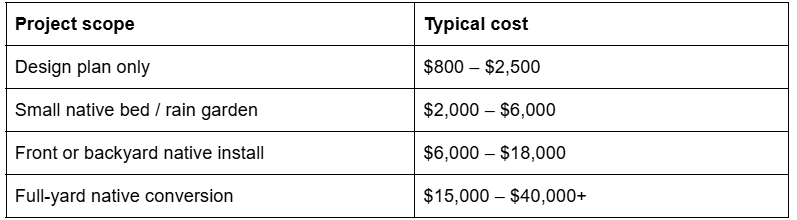
Native plant projects often cost somewhat less than equivalent conventional garden installs because the plant material is locally sourced, requires less soil amendment, and needs no irrigation system once established. The savings compound over time in reduced watering and maintenance costs. We provide a transparent estimate after evaluating your specific lot, sun, and drainage conditions.
Are native plant gardens low maintenance in Oregon rain?
Yes — and this is the most important practical benefit for Beaverton homeowners. Once an Oregon native garden is established, our rain does most of the work: the wet season from October through May provides more than enough water for native plants to thrive, and the dry summer months align with the drought dormancy these plants evolved to handle. Compared to a conventional lawn or ornamental garden, a well-designed native garden needs a fraction of the irrigation, feeding, and chemical inputs.
"Low maintenance" doesn't mean "no maintenance." Year one requires some watering while roots establish, seasonal cleanup keeps the garden tidy, and occasional division or editing keeps plants in bounds. But the ongoing commitment is genuinely light compared to most residential gardens, and it gets easier as the garden matures and fills in.
Serving Beaverton and Washington County
HD Landscape and Maintenance provides native plant garden design Beaverton OR and across the Washington County area, including:
Beaverton — native gardens from simple rain gardens to full-yard conversions
Hillsboro — Oregon native landscaping Hillsboro OR from first consultation through installation
Tigard, Aloha, and Sherwood
The greater Pacific Northwest garden design Washington County OR region
We're locally based, Oregon LCB #9977, insured, rated 5.0 across 302 Google reviews, and genuinely committed to planting species that belong in this landscape.
Frequently Asked Questions
What native plants grow best in Beaverton OR gardens?
Top performers for Beaverton include Oregon grape, red flowering currant, camas, and sword fern for sun and part-shade; salal, red-twig dogwood, and trillium for shade; and blue flag iris and slough sedge for wet or drainage areas. These natives are proven for our clay soil, wet winters, and dry summers, and they attract pollinators, hummingbirds, and birds.
Why choose native plants for garden design in Oregon?
Oregon natives require far less water once established, need minimal fertilizing or spraying, support native pollinators and birds, manage stormwater more effectively than lawns, and reduce long-term maintenance costs. They're also well-adapted to our clay soil and dry-summer/wet-winter cycle, so they perform reliably without fighting the climate.
How much does native plant garden design cost in Beaverton?
A design plan alone runs $800 to $2,500, a small native bed or rain garden $2,000 to $6,000, and a front or backyard native install $6,000 to $18,000. Full-yard native conversions run $15,000 to $40,000 or more. Native installs often cost less than equivalent conventional gardens because local plant material needs less soil amendment and no permanent irrigation system.
What is a Pacific Northwest garden design style?
It's a layered, naturalistic approach built around the character of our regional landscape: structural evergreens like Oregon grape and sword fern, layered planting that mirrors the forest understory, rain gardens that work with our rainfall, naturalistic informal shapes, and natural materials. It's designed with the climate and ecology rather than against them.
Are native plant gardens low maintenance in Oregon rain?
Yes, once established. Oregon's wet season provides the water native plants evolved for, and the dry summer aligns with their natural drought dormancy. Compared to conventional lawns or ornamental gardens, a well-designed native garden needs a fraction of the irrigation, fertilizing, and chemical inputs. Year one requires establishment watering, but ongoing maintenance is genuinely light.
Visit or Call Us
HD Landscape and Maintenance 6581 SW 192nd Beaverton, OR Phone: (971) 336-5520 Hours: Mon–Sat: 7am – 7pm | Sun: Closed Oregon LCB Lic. #9977 | Licensed & Insured | 5.0 Google Rating (302 Reviews)
Serving Beaverton and the surrounding Washington County area, including Hillsboro, Tigard, Aloha, and Sherwood.
Request a free native garden design consultation or call (971) 336-5520.
