HD Landscape and Maintenance installs paver driveways in Portland, OR — 80mm vehicular-rated units laid in herringbone over a compacted base built for vehicle loads. Two things separate a driveway from a walkway here: most driveways exceed Portland’s 500 square foot stormwater trigger, and the apron sits in the public right-of-way under a separate PBOT permit. Oregon LCB #9977.
By Donavan Hesedahl, Owner/Operator · Last updated July 2026
Are permeable pavers required for driveways in Portland?
Still not required — but for a driveway the practical answer is very different from a walkway.
Portland’s 2025 Stormwater Management Manual triggers at 500 square feet of new or replaced impervious surface. There is an exemption from providing a separate stormwater facility for drainage basins totalling 500 square feet or less of pedestrian-only impervious surface or residential driveway, provided runoff can’t be routed to other proposed facilities and sheds to adjacent pervious areas where feasible.
Here’s why that lands differently. A front walkway is typically 120 to 240 square feet — comfortably under. A Portland driveway running from the street to a detached garage at the back of the lot, which is the classic configuration in Southeast and Northeast Portland, is commonly 400 to 800 square feet, and a double-wide or one with a parking pad goes well past that. Add the apron and any adjoining patio and you’re over.
So for driveways the question isn’t usually “am I exempt” — it’s “how am I managing the stormwater.” The SWMM works infiltration-first, then detention with water quality treatment, then discharge to the city system as a last resort. Permeable pavers are one approved way to satisfy the infiltration end of that hierarchy, and on a driveway they’re often the most economical one, because the alternative is building a separate facility somewhere on the lot.
Two more driveway-specific triggers worth knowing:
- Replacing an existing driveway counts. The threshold reads new or replaced impervious surface. Tearing out old concrete and putting down pavers of the same footprint can still bring the project into scope.
- Reconfiguration can pull stormwater in through the back door. PBOT’s driveway standards require driveways accessing a roadway classified Neighborhood Collector or higher to allow forward-motion ingress and egress — no backing out. Where that means adding an on-site turnaround, the city notes it may trigger zoning or stormwater management requirements related to new or modified paving. A driveway project that started as resurfacing can become a stormwater project.
Get this scoped before you choose a material. BES takes homeowner stormwater and drainage questions.
The apron is in the right-of-way — that's a separate permit
This is the part that catches people, and it’s the biggest procedural difference between a driveway and anything else in your yard.
Your driveway has two halves under two different authorities. The portion on your property is yours. The apron — the ramp between the roadway and your property line, crossing the sidewalk and curb — is in the public right-of-way and falls under the Portland Bureau of Transportation, not the Bureau of Development Services.
What that means practically:
- PCC 17.28 and PBOT’s TRN-10.40 govern driveways accessed from a City of Portland right-of-way, and those standards always apply. City code defines a driveway as a gravel or paved way for vehicular traffic extending from the roadway to the adjacent property line, providing access to parking.
- PBOT authorises curb cuts, and only to access legal vehicle parking or loading space. If your project involves a new or widened curb cut, that’s a PBOT authorisation, not something a contractor can simply build.
- Apron work runs on a PBOT permit with city standard drawings — staff select the applicable standard for your location, and final design details come from the permit inspector. Work must pass final inspection.
- Timelines are real. PBOT notes application processing can take up to seven business days, with the permit typically issued one to two business days after payment. Not long, but it’s not same-day either — worth building into a schedule.
- Different jurisdiction, different rules. Where the right-of-way is managed by ODOT, Multnomah County, Washington County, or Gresham rather than the City, you have to deal with that agency as well.
There’s also a driveway design exception process where the standards can’t reasonably be met — relevant on the steep, narrow-frontage lots common in Southwest and Northwest Portland.
The practical advice: confirm apron scope before pricing. A homeowner who budgets for pavers to the property line and then discovers the apron needs replacing under a separate permit has a nasty surprise mid-project.
What actually makes a driveway different from a walkway
Not the pavers you can see. Everything underneath, plus one detail on the surface that people get wrong constantly.
Unit thickness. Pedestrian applications use 60mm (about 2⅜ inch) pavers. Vehicular applications need 80mm (about 3⅛ inch). This is the single most common corner cut in residential paver driveways, and it’s invisible on handover day. A 60mm paver under a vehicle will eventually crack or rock.
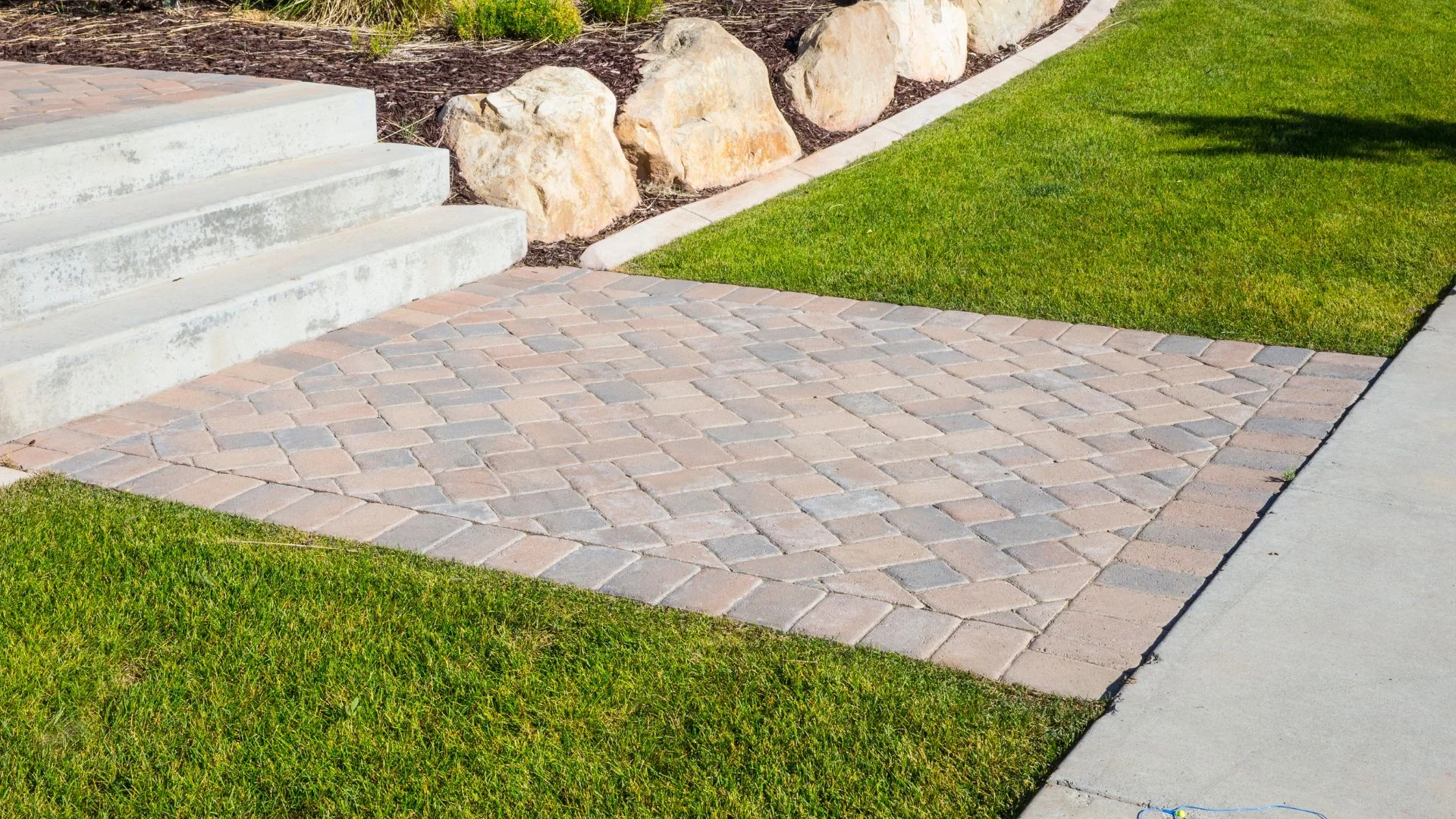
Pattern is structural, not decorative. For vehicular surfaces the pattern must be herringbone — 45° or 90°. Herringbone interlocks so that units resist rotation and creep under turning and braking loads. Running bond and stack bond have continuous joint lines that let the field walk under vehicular stress. On a walkway a running bond is fine and looks clean. On a driveway it’s a defect. If a bid specifies a stack or running bond for a driveway, that’s the tell.
Base depth roughly doubles. A pedestrian walkway might sit on four to six inches of compacted crushed aggregate. A residential driveway needs meaningfully more — commonly eight to twelve inches depending on subgrade, and more on soft clay. Portland’s heavy clay subgrades are on the demanding end of that range.
Geotextile separation matters more. A woven geotextile between subgrade and base keeps clay from pumping up into the aggregate under repeated loading. On a walkway it’s good practice; under vehicles on wet clay it’s what keeps the base from turning to mush over a decade.
Edge restraint is load-bearing. Vehicle loads push outward at the perimeter, particularly where cars turn. Restraint has to be properly spiked and, at the apron and turning areas, sometimes upgraded to a concrete haunch.
Same principle as retaining walls in Portland and paver walkways: what you see is the smallest variable. The base decides whether it lasts.
How do paver driveways hold up in Oregon rain — and can they take heavy vehicles?
Rain: better than concrete, for a structural reason. A paver driveway is a flexible system — individual units move independently and sand-filled joints absorb movement that would crack a monolithic slab. Portland sits in USDA Zone 8b with winter minimums around 15–20°F, so freeze-thaw is mild here by national standards. What fails is the base, and the cause is water: inadequate depth, poor compaction, no geotextile on clay, missing edge restraint, or water routed under the driveway rather than away from it.
The corollary is the real advantage: when a paver driveway does settle, you lift the affected area, correct the base, and relay the same units. A cracked concrete driveway gets demolished.
Heavy vehicles: yes, and this is genuinely one of the strongest arguments for pavers. Interlocking concrete pavers are used in port terminals, container yards, and airport aprons precisely because the segmental system distributes concentrated point loads and tolerates repeated heavy traffic better than a slab. On a residential driveway built correctly — 80mm units, herringbone, properly depth-compacted base — delivery trucks, moving vans, and RVs are not a problem.
The caveats are about construction, not the product. Undersized units, insufficient base, or a running-bond pattern will fail under load no matter how good the pavers are. And if you’re regularly parking an RV or a heavy work truck, say so at the quoting stage so the base gets specified for it rather than assumed.
What do driveway pavers cost, and are they worth it?
Driveway pavers cost more up front than poured concrete and meaningfully more than asphalt. The honest case for them rests on three things rather than on price.
Repairability. Individual units lift and relay. Oil-stained pavers get swapped. A settled section gets corrected without a seam or a colour-mismatched patch. Concrete offers none of this — every repair is visible.
Lifespan. A correctly built paver driveway should outlast a concrete driveway comfortably, and the failure mode is fixable rather than terminal.
Stormwater and resale. On a Portland lot where the driveway crosses the 500 square foot threshold, a permeable paver system can satisfy the infiltration requirement while serving as the driveway — one expense doing two jobs. Kerb appeal is real too, though it’s the softest of the three arguments.
Where they’re not worth it: a short, flat, easily accessed driveway you plan to sell in two years, or a budget where the honest choice is between properly built concrete and an under-specified paver installation. An under-built paver driveway is worse than good concrete.
Cost drivers: total square footage, paver material and thickness, base depth required by subgrade, excavation and spoil disposal, site access and slope, whether the apron is in scope under a PBOT permit, whether stormwater management is triggered, and demolition of existing surface.
We quote after confirming subgrade condition, access, apron scope, and stormwater status — the four things that move the number most.
Sealing and maintenance on a paver driveway
Sealing a driveway has a stronger case than sealing a walkway, and it’s worth being specific about why: driveways get oil, transmission fluid, and coolant drips. A penetrating sealer makes those stains far easier to lift. That’s a functional reason a walkway doesn’t have.
The trade-offs from this climate still apply. Sealers need a properly dry substrate, and Portland’s window for that is narrow. Film-forming sealers can make a surface slicker when wet. And it’s recurring — typically every three to five years.
Never seal a permeable driveway. Sealing closes the joints, which is the whole mechanism, and it can undo the stormwater basis the project was approved on.
Ongoing maintenance:
- Joint sand top-up. Polymeric sand resists washout and suppresses joint weeds; expect to refresh it over the years, sooner in turning areas where tyre scrub is worst.
- Spot re-levelling. Any settlement gets lifted and corrected early, before it spreads.
- Oil stain treatment, and unit replacement where a stain won’t lift. Keep a small stock of spare pavers from the original batch — dye lots change.
- Moss and algae on shaded driveways, which is a traction issue on any sloped Portland driveway, not just a cosmetic one.
- Permeable systems need periodic vacuuming of the joint aggregate. Skip it and the system silts closed within a few years — and a permeable driveway that no longer infiltrates may no longer meet the terms it was permitted under.
Portland neighborhoods and Multnomah County areas we serve
We’re based in Aloha and work throughout Multnomah County and the Portland metro.
- Southeast and Northeast Portland — Laurelhurst, Mt. Tabor, Richmond, Woodstock, Sellwood, Irvington, Alameda, Rose City Park, Concordia. The long street-to-detached-garage driveway is the standard configuration here, which is exactly the layout that crosses the stormwater threshold. Mature street trees also make apron and root conflicts common.
- Southwest Portland and the West Hills — Hillsdale, Multnomah Village, Portland Heights, Council Crest. Steep, short-frontage driveways where design exceptions and traction on slope both come up.
- North Portland — St. Johns, Kenton, Overlook, Arbor Lodge. Flatter, straightforward access, most predictable installations.
- Northwest Portland — Nob Hill, Willamette Heights. Tight lots, constrained access, protected trees close to the work.
Outside Portland proper we serve Gresham, Beaverton, Tigard, Lake Oswego, Tualatin, Hillsboro, and Aloha. Thresholds and right-of-way authority differ by jurisdiction — Portland’s 500 square foot trigger and PBOT apron process don’t apply in Beaverton or Gresham, and we confirm the governing agency before quoting.
HD Landscape and Maintenance is an Oregon LCB-licensed landscape contracting business — license #9977, which covers planning and installing driveways and paving. Request a free Portland paver driveway quote →
Frequently Asked Questions
Are permeable pavers required for driveways in Portland?
No, but the practical picture differs from walkways. Portland’s 2025 Stormwater Management Manual triggers at 500 square feet of new or replaced impervious surface, with an exemption from providing a separate facility for basins totalling 500 square feet or less of pedestrian-only surface or residential driveway. A typical Portland driveway running street-to-garage is commonly 400 to 800 square feet, and double-wide driveways exceed that, so most driveway projects fall into scope rather than out of it. Replacement counts as well as new construction. Permeable pavers are one approved way to satisfy the manual’s infiltration-first hierarchy, and on a driveway they’re often cheaper than building a separate stormwater facility elsewhere on the lot.
Do paver driveways need to be sealed?
Not required, but there’s a better case for sealing a driveway than a walkway: driveways collect oil, transmission fluid, and coolant, and a penetrating sealer makes those stains much easier to lift. The trade-offs still apply — sealers need a dry substrate and Portland’s window is narrow, film-forming products can make the surface slicker when wet, and it needs redoing every three to five years. Permeable driveways should never be sealed, since sealing closes the joints that make them function and may void the stormwater basis for the permit.
Can paver driveways handle heavy vehicles?
Yes. Interlocking concrete pavers are used in port terminals, container yards, and airport aprons because the segmental system distributes concentrated point loads and tolerates repeated heavy traffic better than a monolithic slab. On a residential driveway that requires three things: 80mm vehicular-rated units rather than 60mm pedestrian units, a herringbone pattern so units resist rotation under turning and braking loads, and a base compacted to vehicular depth — commonly eight to twelve inches of aggregate depending on subgrade. Built that way, delivery trucks, moving vans, and RVs are fine. Mention regular RV or heavy truck parking at the quoting stage so the base is specified for it.
How do paver driveways hold up in Oregon rain?
Better than concrete, structurally. A paver driveway is a flexible system in which units move independently and sand-filled joints absorb movement that would crack a slab, and Portland’s Zone 8b winters are mild for freeze-thaw. What fails is the base, and water is the cause: insufficient depth, poor compaction, no geotextile separation on clay subgrade, missing edge restraint, or water routed under the driveway instead of away. The advantage is that settlement is repairable — lift the area, correct the base, relay the same units — where a cracked concrete driveway has to be demolished.
How often do paver driveways need maintenance?
Light but ongoing. Joint sand needs topping up periodically, sooner in turning areas where tyre scrub is heaviest. Any settlement should be lifted and corrected early rather than left to spread. Oil stains want treating when fresh, with unit replacement as the fallback — keep spare pavers from the original batch, since dye lots change. Shaded driveways need moss and algae cleaning, which is a traction matter on any Portland slope. Permeable systems additionally need periodic vacuuming of the joint aggregate; skipping it silts the system closed within a few years and can put it out of compliance with its permit.
How long do paver driveways last?
A correctly built paver driveway should last 30 to 50 years or more, and unlike concrete its failure mode is repairable rather than terminal — settled sections get relaid and damaged units get swapped. Lifespan depends far more on base construction, unit thickness, and drainage than on the pavers themselves. An under-specified installation with 60mm units or a shallow base can begin rocking and settling within five years regardless of surface quality.
Visit or Call Us
HD Landscape and Maintenance LLC 7940 SW 191st Ave Aloha, OR 97007
Phone: (971) 336-5520
Email: hdlandscapellc@gmail.com
Hours: Monday–Saturday, 7:00 am – 7:00 pm · Sunday closed
Oregon LCB Lic. #9977 · Licensed & Insured
Serving Portland and surrounding areas including Southeast, Northeast, Southwest, North, and Northwest Portland, plus Gresham, Beaverton, Tigard, Lake Oswego, and Multnomah, Washington, and Clackamas counties.


 4.9Top Rated Service 2026verified by TrustindexTrustindex verifies that the company has a review score above 4.5, based on reviews collected on Google over the past 12 months, qualifying it to receive the Top Rated Certificate.