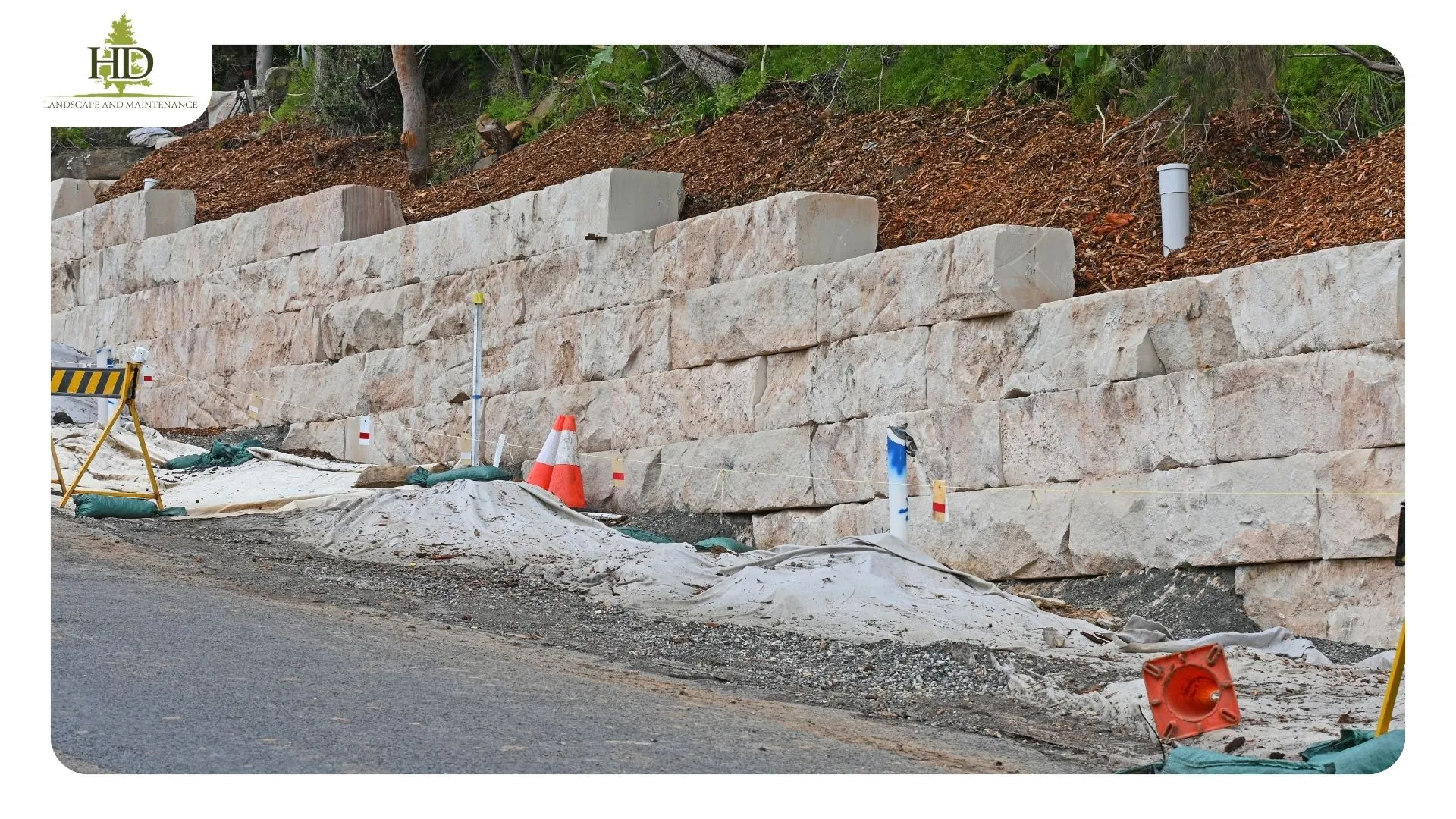
Why a Clackamas County hillside wall is a land-use question first
Most homeowners call us asking about block, height, and price. On an unincorporated Clackamas County hillside, those are the third set of questions, not the first.
The county regulates development on slopes under its Zoning and Development Ordinance before the building code ever gets involved. That means a wall on a steep lot can be perfectly sound engineering and still be the wrong project, because the grading it requires exceeds what the site is permitted to absorb.
This catches people out constantly. A neighbour built something similar two years ago, or a contractor in Portland quoted the same job without blinking — and neither fact tells you anything about what applies at your address. It is the single biggest difference between hillside work here and the flatter Washington County lots we also serve.
The 20 percent slope rule that decides your project
Twenty percent is the number to know.
Under ZDO Section 1002.01, development on slopes at or above 20 percent and up to 35 percent requires review of a Type I application. For residential development in the county’s RR, MRR, and HR districts, that upper limit drops to 25 percent. Push past those ceilings and it becomes a Type II application instead — a materially heavier process.
Two standards inside that section shape hillside wall design more than anything in the building code:
A hard cap on disturbance. Grading, stripping of vegetation, and lot coverage by structures and impervious surfaces are limited to no more than 30 percent of slopes 20 percent or greater. Your wall, its excavation footprint, and any patio or path arriving with it all draw from the same 30 percent budget. Spend it on the wall and the terrace above it may not fit.
A requirement to prove the ground will hold. On slopes above the Type II threshold, an engineering geologic study approved by the county must establish that the site is stable for the proposed development, and its recommendations get built into the plans. Separately, under ZDO Section 1003.02, an engineering geologic study is required for development proposed on slopes of 20 percent or greater in mapped mass movement hazard areas. The county’s primary reference for identifying those areas is DOGAMI Bulletin 99 and its accompanying maps.
That study is not a formality. It has to be signed by an engineer or engineering geologist registered in Oregon, and it has to include specific recommendations for cut slope stability and seepage and drainage control. Those recommendations then govern the wall.
Why terracing is often the wrong instinct here
Ask around and you will be told to break one tall wall into two or three short ones. On a Clackamas County hillside, that advice can work against you.
ZDO 1002.01 states directly that creation of building sites through mass pad grading and successive padding or terracing of building sites shall be avoided. The ordinance also requires buildings to be clustered specifically to reduce alteration of terrain.
The logic is about the slope as a whole rather than any single wall. Terracing feels conservative because each individual structure is short, but it disturbs far more ground than one properly engineered wall does, and the county is regulating total disturbance. Add the structural reality — tiers placed close together load each other, so the lower wall carries the upper one — and a terraced scheme can end up both harder to approve and harder to engineer than the single wall it was meant to avoid.
We have redesigned more than one Stafford-area project from three tiers back to one wall for exactly this reason.
The tree rule that quietly catches wall backfill
This one surprises nearly everyone, and it is specific to land inside the Portland Metropolitan Urban Growth Boundary.
Clackamas County defines tree removal to include effective removal through damage to a tree or its root system — and the ordinance names placing fill in excess of six inches deep over the root zone as an example. You do not have to cut anything down to have removed a tree in the county’s eyes.
Backfilling behind a new wall can do precisely that to the firs and big-leaf maples standing above it.
The consequence is not a fine. Removing more than three non-exempt trees on a lot of record in a calendar year is excessive tree removal, and if excessive removal occurred in the five years before a complete application is filed for design review, a subdivision, or a partition, that application will be denied. Trees under six inches diameter at breast height are exempt, as are nuisance and hazardous species on the county’s list.
So the grading plan and the root zones have to be worked out together, before a machine arrives. On wooded Redland and Beavercreek lots we routinely shift a wall alignment several feet upslope to keep fill depths off the root plates of trees the owner wants to keep.
Three permit tracks, and which jurisdiction you’re actually in
A hillside wall here can touch three separate approvals:
- Building permit. Required for retaining walls greater than four feet in height, and for any wall carrying a surcharge — a driveway, a structure, or a slope sitting above it. Height is measured from the bottom of the footing, not from the ground you’re standing on, so a wall that reads as three feet from the patio can cross the line once its buried base is counted.
- Grading. Excavation and grading is governed separately under Chapter 9.03 of the Clackamas County Code. Thresholds turn on the volume of cut and fill, which is why we calculate earthwork quantities before quoting rather than after. Confirm the current figures with the county for your specific site.
- Land use. The Type I or Type II hillside review described above, where slope triggers it.
Then there is the question of who reviews it at all. Plenty of properties with a Lake Oswego or Oregon City mailing address sit outside those city limits in unincorporated Clackamas County, and the rules differ meaningfully. Inside Lake Oswego’s city limits the city’s own thresholds apply, including a surcharge trigger lower than the county’s and a separate measurement method for walls acting as seawalls along the lake — covered in our guide to retaining walls in Lake Oswego. Across the river in Portland, Portland’s own retaining wall code applies instead.
Checking the jurisdiction is the first thing we do. It is free, it takes minutes, and getting it wrong costs months.
Drainage on a slope the county has mapped
Standard practice behind a block wall — free-draining rock, a perforated pipe taken to a real outlet, fabric between rock and native soil — applies everywhere in this climate. On a mapped hillside, one county rule changes where that water is allowed to end up.
Within mass movement hazard areas, ZDO 1003.02 prohibits the diversion of storm water into those areas. A drain line that solves your wall’s problem by discharging onto the unstable slope below is not a legal outlet. The same section requires vegetative cover to be maintained or established for stability and erosion control.
In practice this means the wall’s drainage design and the property’s overall water routing have to be solved as one problem. Where the outlet ends up is usually the hardest constraint on a steep lot, and it is worth resolving before the wall is designed rather than after.
How much does a retaining wall contractor charge in Clackamas County?
We quote per project in writing after a site visit, and on hillside work the variables are wider than most trades.
- Slope percentage, because it determines which review track applies and whether an engineering geologic study is required.
- The 30 percent disturbance budget, which can force a redesign before pricing means anything.
- Height and surcharge, which drive stamped engineering independently of slope.
- Earthwork volume, both for cost and for the grading threshold.
- Tree protection, where root zones constrain alignment, fill depth, and machine routes.
- Access, which on these lots is often the largest single factor — no machine route means every ton moves by hand.
- Outlet distance for drainage, which on a steep site can exceed the cost of the wall’s visible face.
We do not quote hillside walls over the phone. The site visit and the written estimate are free, and nothing starts until you have approved the number in writing.
Where we build hillside walls in Clackamas County
We work throughout Clackamas County, Monday to Saturday, from our base in Aloha.
Most of our county hillside work sits in the Stafford and Rosemont corridor, Marylhurst, Oak Grove, Jennings Lodge, and the slopes above Gladstone and Oregon City. We also build in Happy Valley and on the Mount Scott flank, and out into the wooded lots around Redland, Beavercreek, and Damascus where the tree rules bite hardest.
Nearby, see our pages for Clackamas, Lake Oswego, West Linn, and Tualatin. Walls rarely arrive alone — they usually come with grading, planting, and water management, which sit within our hardscaping and outdoor structures and landscape design work. Finished walls are in the portfolio.
Frequently Asked Questions
How much does a retaining wall cost in the Lake Oswego and Clackamas County area?
There is no square-foot rate that survives contact with a real hillside. Cost is driven by slope percentage and the review track it triggers, wall height and surcharge, earthwork volume, tree protection constraints, machine access, and how far drainage has to travel to a legal outlet. We quote in writing after a free site visit rather than guessing over the phone.
Do you offer free retaining wall estimates?
Yes. The site visit and the written estimate are both free, across Clackamas County and the wider Portland metro. On hillside lots that visit includes checking whether your address falls inside a city limit or in unincorporated county, and reading the slope — the two things that determine what you can build.
What approvals are needed for a hillside retaining wall in Clackamas County?
Potentially three. A building permit for walls over four feet measured from the bottom of the footing, or any wall carrying a surcharge. A separate grading approval under Chapter 9.03 of the county code, depending on cut and fill volume. And a Type I or Type II land-use review where the slope reaches 20 percent, which above the higher thresholds brings a county-approved engineering geologic study signed by an Oregon-registered engineer or engineering geologist.
Are you a licensed, bonded and insured Oregon contractor?
Yes. HD Landscape and Maintenance is licensed through the Oregon Landscape Contractors Board, licence #9977, which requires a surety bond and liability insurance to be maintained as a condition of licensure. You can confirm our standing yourself through the Oregon LCB public lookup. Where a wall requires stamped structural engineering, that work is carried out by an engineer registered in Oregon.
How long does it take to build a hillside retaining wall?
Construction is rarely what sets the schedule. A short garden wall runs a few days; a structural wall with proper drainage takes one to two weeks depending on length and access. Land-use review, a geologic study, and stamped drawings add weeks to months ahead of that. Season matters too — the county requires disturbed areas to be compacted where necessary and re-vegetated before the annual wet season, which makes late-summer starts considerably easier than autumn ones.
Ready to find out what your slope will actually allow?
Send us the address and we will tell you which jurisdiction reviews it, roughly where the slope sits against the 20 percent line, and what that means for the wall you have in mind — before anyone talks about price. Call (971) 336-5520
Visit or Call Us
HD Landscape and Maintenance LLC
Adress: 6581 SW 192nd Ave Aloha, OR 97007
Phone: (971) 336-5520
Email: hdlandscapellc@gmail.com
Hours: Monday–Saturday, 7:00 am – 7:00 pm · Sunday closed Oregon LCB Lic. #9977 ·
Licensed, bonded & insured
Serving Clackamas County and the Portland metro, including Lake Oswego, West Linn, Oregon City, Happy Valley, Milwaukie, Gladstone, Oak Grove, Jennings Lodge, Stafford, Damascus, Beavercreek, and Redland.


 4.9Top Rated Service 2026verified by TrustindexTrustindex verifies that the company has a review score above 4.5, based on reviews collected on Google over the past 12 months, qualifying it to receive the Top Rated Certificate.